Is EcoGPT Greenwashing? We Looked at the Evidence
EcoGPT calls itself green AI and plants trees as you chat. But it publishes no energy, carbon or water figures, doesn’t name its models, and can route chats anywhere. Here is the evidence.
EcoGPT has grown fast by promising guilt-free AI: chat as much as you like, and it plants trees. Its App Store subtitle is “Chat to plant trees.” Its website calls it “regenerative, ethical, open source AI” and tells you to “Quit Big AI.”
It is a compelling story. But a green claim is only as good as the evidence behind it, so we went through EcoGPT’s own website, its App Store listing and independent reporting to see what is actually there.
A disclosure first: Viro AI competes with EcoGPT, and EcoGPT has published its own page comparing itself to us. That is exactly why everything below is quoted from EcoGPT’s own pages or from independent sources, all linked at the end. If EcoGPT publishes the figures we say are missing, we will update this article.
What counts as greenwashing?
Greenwashing is when a product presents itself as better for the environment than the evidence shows. The US Federal Trade Commission’s Green Guides put it plainly: broad claims that a product is environmentally beneficial “are difficult to interpret,” are likely to suggest it has no negative impact at all, and because marketers can rarely prove all of that, they “should not make unqualified general environmental benefit claims.”
So the question is simple: what does EcoGPT claim, and what does it show?
1. The claim is in the name, the numbers are missing
“Eco” is the product’s name. The whole brand says this AI is good for the planet. Yet EcoGPT’s own environmental claims page says it doesn’t publish carbon, water or energy estimates, for your chats or for the company, until it can publish the method behind them.
That means there is no figure for how much electricity an EcoGPT answer uses, how much carbon it emits, or how much water it consumes. The green claim is made up front; the evidence is postponed.
2. You don’t know where your chat runs
EcoGPT highlights one data center: Google Cloud’s site in Hamina, Finland, cooled with seawater, with Google reporting 98% carbon-free energy in Finland in 2023. That is a good site.
But the same page adds that “other model providers in other locations also answer chats, and which one serves a reply varies.” Reporting by ForkLog found that EcoGPT falls back to other services, which makes the physical path of a request hard to trace. So the Finnish data center is the best case, not a guarantee. For any given chat, you can’t tell where it ran or what powered it.
3. Trees don’t solve AI’s problem
The trees are real. EcoGPT plants them through Trees for the Future, a respected charity that works with farming families in East Africa, and it shows planting certificates. That is worth something. It just has nothing to do with the environmental cost of AI.
- AI’s footprint is electricity, used the moment you hit send. A tree planted in Kenya doesn’t change what powers the data center that answered you.
- Trees work on a different timescale. Energy is used in seconds; forests take decades to absorb their carbon. ForkLog cites research showing regrowing forests reach peak carbon removal at around 20 to 40 years old.
- Many trees don’t make it. The same reporting cites seedling survival of roughly 36% to 47% in one Kenyan study and 75% in a Ugandan project.
- EcoGPT doesn’t claim the trees offset anything. It publishes a tree count, not a carbon figure, so there is nothing to weigh the trees against.
Experts ForkLog spoke to were blunt. Mikhail Yulkin, CEO of CarbonLab, said: “Planting trees is not a solution to the problem at all.”
4. The app rewards using more AI
EcoGPT earns you a tree every 100 chats, or every 50 on Pro. Its App Store listing describes “a forest world that grows with your trees,” and recent updates add daily word games, puzzles and chess.
That design rewards chatting more. More chats mean more trees in your forest, and also more electricity. An AI that is serious about its footprint should help you use it well, not turn usage into a game.
5. Small, unnamed models: less energy, worse answers
EcoGPT says its models have about ten times fewer active parameters than the big providers’ models, and that is the real source of any energy saving. But it doesn’t say which models they are.
That trade-off matters. How much a language model knows and how well it reasons grows with its size, a relationship researchers have measured since the first scaling-law studies. Smaller models know less, struggle more with hard questions, and are more likely to give a confident wrong answer. Because EcoGPT doesn’t name its models, you can’t look up how they perform or how current their knowledge is.
Using a small model is a reasonable choice for simple tasks. Selling it as a green feature, without telling people what they are giving up, is not.
What EcoGPT gets right
To be fair:
- It works with a real charity and shows its planting certificates.
- It does not claim to be carbon neutral or to offset its emissions with trees.
- It says plainly that it won’t publish figures until it has a method.
- Its main data center is in a low-carbon region.
Those are honest choices. The problem is the distance between them and the brand: a product called EcoGPT, sold as regenerative AI, that cannot yet tell you its energy, carbon or water footprint.
Our verdict
In our view, EcoGPT’s eco claim rests on branding, a tree counter and one good data center, not on measured impact. It publishes no energy, carbon or water figures, doesn’t name its models, can route chats to unnamed providers elsewhere, and rewards people for using more AI. By the standard the FTC sets for broad environmental claims, that is a claim it cannot currently back up.
How to check any “green AI” claim
Ask any AI app, including us, these questions:
- Where do the servers run, and what powers them? Specific places and power sources beat general promises.
- How much energy does an answer use? Look for a published, per-message figure and the method behind it.
- Is it clean power or a side project? Trees, credits and offsets happen somewhere else. Clean power changes what the AI actually runs on.
- What do the numbers leave out? Honest companies say.
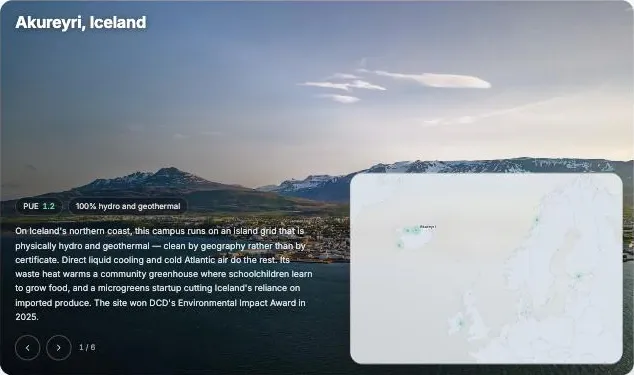
How Viro answers them. Viro’s own model runs in named data centers in Akureyri, Blönduós and Keflavík in Iceland, Glomfjord in Norway, Helsinki in Finland, and Dublin, powered by hydro, geothermal and wind, with no offsets. When you choose ChatGPT, Claude or Gemini, those answers run on their makers’ servers; Viro estimates the electricity each message uses, funds new clean energy to match it, and labels those answers as energy matched rather than 100% clean. Every reply shows its estimated energy. Like nearly all per-message figures, ours cover the electricity to answer you, not training the model or making the hardware. See the data centers.
For a side-by-side of the two apps, read Viro AI vs EcoGPT. For the bigger picture, read what makes AI eco-friendly.
Frequently asked questions
Is EcoGPT greenwashing?
In our view, yes. Its green image rests on its name, its tree counter and one data center in Finland, while it publishes no energy, carbon or water figures, doesn’t name its models, and says other providers in other locations also answer chats. That is the gap between claim and evidence that greenwashing describes.
Does EcoGPT really plant trees?
Yes. EcoGPT plants trees through the charity Trees for the Future and shows planting certificates on its website. The trees are real; the problem is that they don’t address the electricity AI uses, and EcoGPT doesn’t claim they offset its emissions.
Is EcoGPT carbon neutral?
EcoGPT does not claim to be carbon neutral, and it says it does not publish carbon, water or energy estimates for chats or for the company. There is no published figure to judge it by.
What models does EcoGPT use?
EcoGPT does not name them. It says its models have about ten times fewer active parameters than the big providers’ models, and that other model providers also answer chats depending on availability.
What does real green AI look like?
It tells you where the servers are, what powers them, and how much energy each answer uses, and it explains what its numbers leave out. Viro AI names its data centers in Iceland, Norway, Finland and Ireland, runs its own model on hydro, geothermal and wind, and shows the estimated energy of every reply.
Sources
- Our environmental claims, EcoGPT, read November 2026
- How trees work, EcoGPT, read November 2026
- About EcoGPT, EcoGPT, read November 2026
- EcoGPT – Chat to plant trees (App Store listing), Apple App Store, read November 2026
- EcoGPT says it plants trees for prompts: green AI or greenwashing?, ForkLog, September 2026
- Guides for the Use of Environmental Marketing Claims, 16 CFR 260.4, US Federal Trade Commission
- Scaling Laws for Neural Language Models, Kaplan et al., OpenAI, 2020
Cover photo by George Bakos on Unsplash