What Is Eco-Friendly AI? A Plain-English Guide
Eco-friendly AI uses less energy, water and carbon per answer. What actually makes an AI app greener, the difference between “runs on” and “matched” clean energy, and how to check a green claim.
Eco-friendly AI is AI built and run to use as little energy, water and carbon as it can. In practice that comes down to three things: how the data center gets its electricity, how big the model is for the job, and how the servers are cooled. A good eco claim tells you plainly which of these it covers.
The key facts:
- One text question to a modern chatbot uses roughly 0.2 to 0.4 watt-hours, about as much as a TV running for under ten seconds.
- Total demand is growing fast: data centers used about 485 TWh of electricity in 2025 and could reach 950 TWh by 2030.
- The biggest levers are clean power where the servers actually run, right-sized models, and cooling that does not evaporate water.
- “Matched” clean energy is not the same as servers running on a clean grid. Good claims say which they mean.
Why AI has an environmental footprint
Every answer an AI gives is computed on chips in a data center. Those chips draw electricity, the building needs more electricity to cool them, and some cooling systems evaporate water to do it. Making the chips and servers has a footprint too, and so does training a model before anyone uses it.
One answer is small. Google measured its median Gemini text prompt at 0.24 watt-hours, which it compares to watching TV for less than nine seconds. OpenAI says an average ChatGPT query uses about 0.34 watt-hours. The footprint comes from scale: billions of these a day, plus heavier jobs like images, video and long documents.
The International Energy Agency estimates that data centers worldwide used about 485 TWh of electricity in 2025, up 17% in a year, and expects that to roughly double to 950 TWh by 2030, around 3% of global electricity demand. AI-focused data centers are the fastest-growing part: their use grew 50% in 2025.
What makes an AI more eco-friendly
There is no single eco label for AI yet, but the factors that decide its footprint are well understood.
- Where the electricity comes from. The same answer has a very different carbon footprint on a grid run on hydro and wind than on one run on coal or gas. This is the biggest single factor.
- How big the model is. Mistral, which published a full life-cycle study of its own model, found impacts roughly proportional to model size: a model ten times bigger has about ten times the footprint for the same length of answer. Using a smaller model for simple questions saves real energy.
- How long the input and answer are. Energy grows with the amount of text processed. Epoch AI estimates a typical GPT-4o query at about 0.3 watt-hours, but one with a long document attached (around 10,000 tokens) at about 2.5 watt-hours.
- The type of task. Images, video and step-by-step “reasoning” modes use far more than plain text. Researchers benchmarking dozens of models found the most energy-hungry used more than 29 watt-hours on a long prompt, over 65 times the most efficient.
- How the servers are cooled. Evaporative cooling uses water. Cold climates, outside air and closed-loop liquid cooling use far less.
- How efficient the data center is. Power usage effectiveness (PUE) measures how much extra electricity goes to cooling and power distribution on top of the chips. Closer to 1.0 is better.
Clean energy: “runs on” vs “matched”
This is where most eco claims get blurry. There are two common ways a company can say its AI uses clean energy, and they mean different things.
| What it means | What to ask | |
|---|---|---|
| Runs on clean power | The data center sits on a grid, or next to a plant, that is renewable in the place and at the hours it runs. | Where are the data centers, and what powers that grid? |
| Matched | The company buys or funds clean energy equal to what it uses, often somewhere else or at a different time. The servers still draw from their local grid. | Is the matching yearly or hour by hour? Does it fund new projects? |
Matching still supports clean energy, and it is far better than nothing. But it does not change the electricity a given answer actually runs on. Carbon accounting rules are moving in this direction: the GHG Protocol, the standard most companies report under, has proposed requiring clean energy purchases to be matched hour by hour and within the same grid region, rather than in yearly totals.
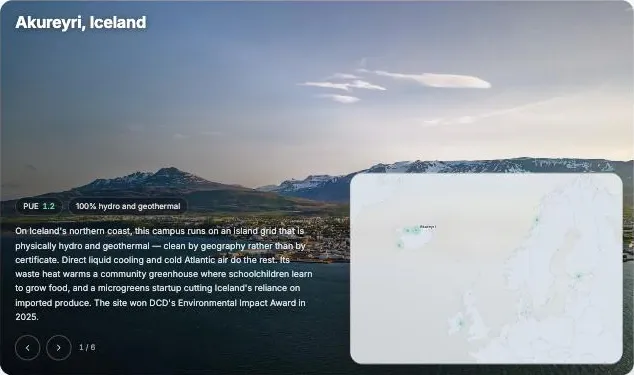
How Viro handles this. Viro’s own model, Viro AI, runs entirely in data centers powered by renewable energy (hydro, geothermal and wind) in Iceland, Norway, Finland and Ireland: clean by geography, not by certificates. When you use partner models like ChatGPT, Claude or Gemini, Viro estimates the energy behind each message and funds matching clean power, and labels the difference so you know which is which. See the data centers.
How to check an eco-friendly AI claim
Before you trust a green label on an AI app, look for straight answers to these questions:
- Where do the servers run? A specific place and power source is a stronger claim than “100% renewable” with no detail.
- Is it “runs on” or “matched”? Both are legitimate, but they are not the same. A trustworthy company tells you which.
- Does it publish numbers per message? Google, Mistral and OpenAI have published per-prompt figures. Many apps publish none.
- Does it count water? Energy is only half the story. See which AI uses the least water.
- Does it rely on carbon offsets? Offsets pay for emissions to be avoided elsewhere. They do not make the AI itself cleaner.
- Does it say what it leaves out? Most per-prompt figures exclude training the model, making the hardware and your own device. Honest figures say so.
What you can do as a user
- Use a smaller, faster model for everyday questions and save the largest ones for hard problems.
- Skip “reasoning” or “deep thinking” modes when a quick answer will do.
- Generate images and video when you need them, not ten variations by habit.
- Attach only the part of a long document that matters: the whole file is processed every time.
- Pick an AI app that is open about where its power comes from.
Keep it in proportion, though. A typical text answer uses less electricity than a few minutes of an LED bulb. The bigger wins come from how AI is built and powered at scale, which is why the choice of provider matters more than any one prompt. For the bigger picture, read is AI bad for the environment?
Try Viro AI free: ChatGPT, Claude, Gemini and Viro’s own renewable-powered model in one app.
Frequently asked questions
Is any AI completely eco-friendly?
No. Every AI answer uses some electricity, and making the chips and data centers has a footprint of its own. Eco-friendly AI means using much less energy, water and carbon per answer, mainly through clean power, right-sized models and low-water cooling.
What is the most eco-friendly AI?
The greenest AI runs a right-sized model in a data center powered directly by renewable energy, with cooling that does not evaporate water, and says so in detail. Viro AI’s own model runs in data centers powered by hydro, geothermal and wind in Iceland, Norway, Finland and Ireland.
What is the difference between eco-friendly AI and green AI?
In everyday use they mean the same thing: AI designed to reduce its energy use, carbon emissions and water use. Researchers sometimes use “green AI” for research that treats efficiency as a goal alongside accuracy.
Do smaller AI models use less energy?
Yes. Mistral found environmental impacts roughly proportional to model size for the same length of answer, and independent benchmarks find the most energy-hungry models use over 65 times more energy per long prompt than the most efficient ones.
Are carbon offsets the same as clean energy?
No. Offsets pay for emissions to be reduced somewhere else. Clean energy changes the power the servers run on, either directly, when the data center is on a renewable grid, or through matching, when the company funds clean energy equal to what it uses.
Sources
- Key Questions on Energy and AI, International Energy Agency, 2026
- How much energy does Google’s AI use? We did the math, Google Cloud, August 2025
- The Gentle Singularity, Sam Altman, OpenAI, June 2025
- Our contribution to a global environmental standard for AI, Mistral AI, July 2025
- How much energy does ChatGPT use?, Epoch AI, February 2025
- How Hungry is AI? Benchmarking Energy, Water, and Carbon Footprint of LLM Inference, Jegham et al., arXiv, November 2025
- Upcoming Scope 2 Public Consultation: Overview of Revisions, GHG Protocol, September 2025
Cover photo by Nuno Marques on Unsplash