What Is the Antalya AI Pledge? We Read It, Then Signed It With Numbers
The Antalya Artificial Intelligence Pledge launches at COP31 on 16 November 2026. Here's what it commits signatories to, what critics say it's missing, how to sign, and the targets Viro AI filled in.
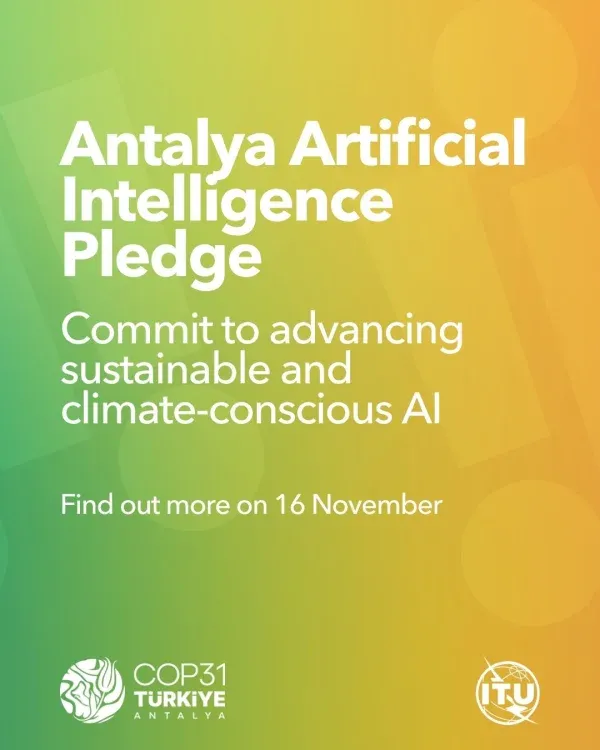
On 16 November 2026, at the UN climate summit in Antalya, Türkiye, governments and companies are being asked to sign the Antalya Artificial Intelligence Pledge: a promise to make AI “part of the climate solution.”
We read the whole thing. Then Viro signed it, and filled in the blanks with real numbers.
Here’s what the pledge says, what it leaves out, who can sign, and exactly what we committed to.
The short answer
- What it is: a voluntary pledge on AI and climate from Türkiye’s COP31 Presidency and the UN’s International Telecommunication Union (ITU).
- What it asks: power AI with clean energy, build it efficiently, measure and report its environmental impact, and help developing countries use AI for climate action.
- What it isn’t: binding. It “creates no new obligations,” in its own words, and sets no shared deadlines.
- Who can sign: countries, plus companies, investors, research institutions, cities and civil society groups. It stays open until COP32.
- What Viro committed to: 100% clean power for our own AI, which is already the case, and public energy numbers for our AI, measured to the ITU’s standard by 2027.
What the Antalya AI Pledge says
The pledge opens by recognising that AI can help with climate change, and that it’s also using a lot more electricity, water, land and materials. It cites the International Energy Agency: electricity use by AI-focused data centres rose by 50% in 2025.
Its stated ambition is AI that’s “sustainably powered, efficiently designed, transparently measured and available to all.” Signatories commit to four broad actions:
- Power and build AI sustainably: more data centres on zero- and low-emission energy, efficient cooling, energy and water efficiency, and fairly sharing the cost of grid upgrades.
- Design and buy AI responsibly: use international standards on AI’s environmental footprint, and recycle and reuse hardware.
- Measure and report AI’s environmental impact, using internationally recognised standards such as the ITU’s new L.1801 guidelines.
- Fund and support AI for climate action in developing countries, least developed countries and small island states.
Then comes the part that matters: an annex of specific commitments. Signatories pick at least one. For companies, the commitments come with blanks to fill in, like:
- “To achieve [X]% of our AI infrastructure operations powered by zero- and low-emission energy by [X].”
- “To assess and publicly disclose the energy and environmental impacts of [X]% of our recently released AI systems by [X].”
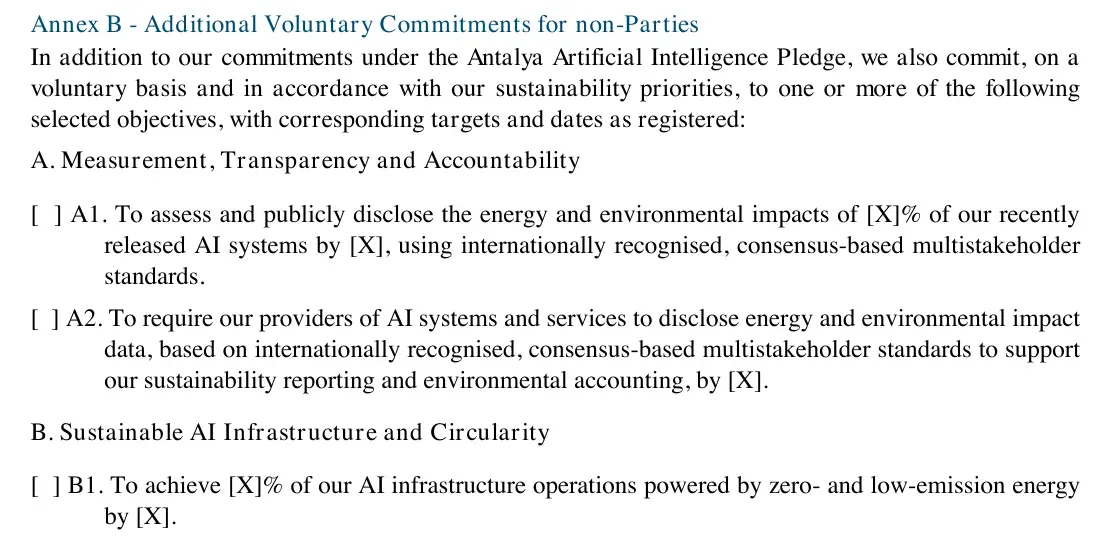
The blanks, straight from the pledge text. Every company writes its own numbers.
Other options cover green data centre requirements, efficient model design, recycling, training people in sustainable AI, and funding AI climate projects.
Progress gets reviewed at every UN climate summit until 2030, starting with COP32 in Addis Ababa, through the ITU’s Green Digital Action initiative.
What the pledge leaves out
The direction is right. The teeth are missing.
- It’s voluntary by design. The text calls its objectives “voluntary and non-prescriptive” and says they create “no new obligations.”
- No shared deadlines. Each signatory fills in its own targets and dates. The word “progressively” appears 10 times.
- Lots of escape hatches. “National circumstances” appears 7 times.
- It never names the problem fuel. “Fossil fuels,” “coal” and “natural gas” appear zero times, in a pledge about AI’s energy use.
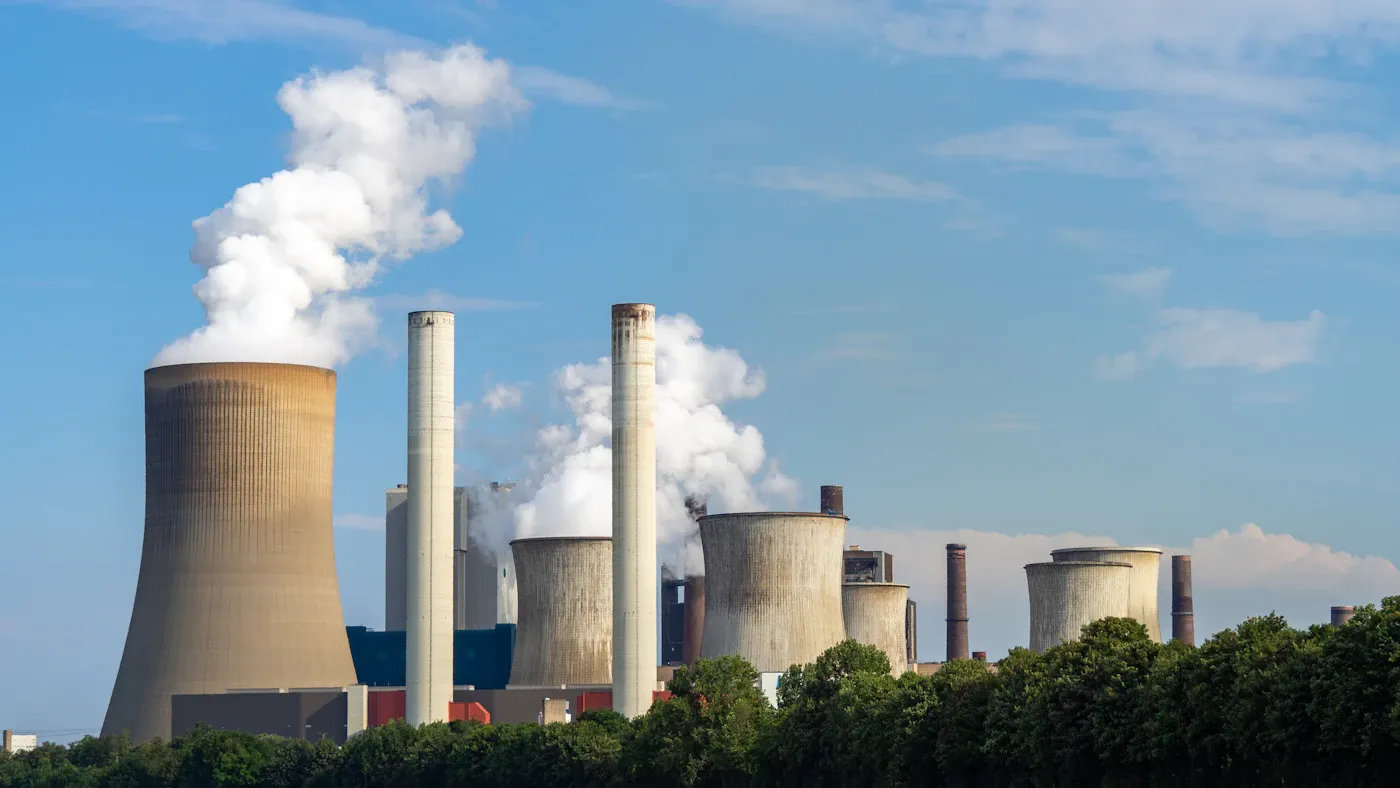
The word the pledge never uses. Niederaußem power plant, Germany. Photo by Wim van ’t Einde on Unsplash.
Critics have said the same. Evan Tachovsky of the World Resources Institute said it “lacks the accountability mechanisms” to steer countries and tech companies onto a better path. Alli Finn of the AI Now Institute put it more bluntly: “we can’t trust them to grade their own homework.”
That’s fair. A pledge you write your own targets for is only as good as the targets people write. So here are ours.
What Viro committed to
We picked two commitments and filled in every blank.
Clean power: 100%, already done
Viro AI, our own model, runs in data centers in Akureyri, Blönduós and Keflavík in Iceland, Glomfjord in Norway, Dublin in Ireland and Helsinki in Finland, on grids powered by hydro, geothermal and wind. You can see where each one is on our data centers page.
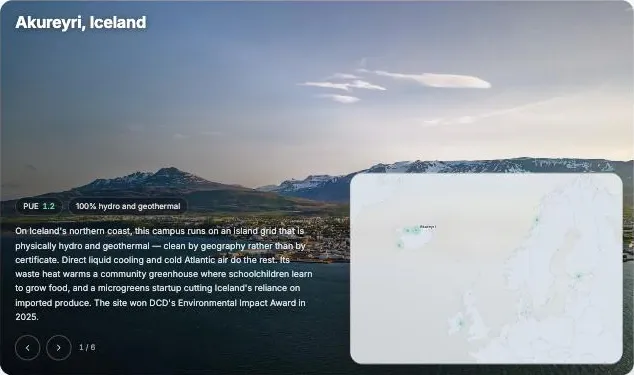
To be precise about what this covers: it’s the AI infrastructure we run. Viro also lets you use ChatGPT, Claude and Gemini, and those run in their makers’ own data centers, which we don’t control. The app labels them Energy matched: we fund new renewable energy to cover the electricity your chats with them use. That’s a real difference, and we’d rather say it than blur it. (More on what makes a data center clean in our guide to AI data centers.)
Disclosure: every reply, measured to the UN standard by 2027
Every reply in Viro already shows an estimate of the electricity it used, so you can see your footprint instead of guessing. How we calculate it is published.
The pledge asks for disclosure “using internationally recognised, consensus-based multistakeholder standards.” The ITU published one this year: L.1801, guidelines for assessing the environmental impact of AI systems. By 2027, we’ll measure Viro’s numbers against it.
We’re a small team. If we can fill in these blanks, so can Amazon, Google, Microsoft, Meta and OpenAI.
How to sign the Antalya AI Pledge
If you run a company, university, city or nonprofit:
- Read the pledge text. It’s six pages; the commitments are in the annexes at the end.
- Pick at least one commitment that fits what you do. If you build or run AI, look at the clean-power and disclosure ones. If you buy AI, there’s one for requiring your providers to disclose their energy data.
- Fill in real numbers. A percentage and a date. That’s what turns a pledge into a promise.
- Sign through the ITU’s Green Digital Action form. The ITU reviews each submission. Endorsement stays open after COP31 and through to COP32.
Why this matters if you just use AI
You don’t have to sign anything. But you can choose AI from companies that publish their numbers.
Ask any AI app three questions: Where does it run? What powers those data centers? How much energy does my chat use? If they can’t answer, that’s an answer. (Here’s our guide to eco-friendly AI with the full checklist.)
Try Viro AI free: the same kind of answers you get from ChatGPT, on clean power, with the energy of every reply on screen.
Frequently asked questions
What is the Antalya AI Pledge?
A voluntary pledge on AI and climate, developed by Türkiye's COP31 Presidency with the International Telecommunication Union (ITU) and launched at COP31 in Antalya on 16 November 2026. Signatories commit to power AI more cleanly, design it more efficiently, measure and report its environmental impact, and help developing countries use AI for climate action.
Is the Antalya AI Pledge binding?
No. The text calls its objectives voluntary and non-prescriptive and says they create no new obligations. Signatories choose their own commitments, and companies fill in their own percentages and dates.
Who can sign the Antalya AI Pledge?
Countries, and non-Party stakeholders: businesses, investors, financial institutions, research institutions, international organisations, cities and regional governments, and civil society groups. Organisations sign through the ITU's Green Digital Action sign-up form and pick at least one commitment.
Can you still sign after COP31?
Yes. Endorsement stays open after COP31 and through to COP32. Signatories are invited to take stock of progress at each UN climate summit until 2030, starting with COP32.
Does the pledge mention fossil fuels?
No. The words fossil fuels, coal and natural gas don't appear in it. It talks about increasing the share of AI powered by zero- and low-emission energy instead.
What did Viro commit to?
Two things: 100% of Viro's own AI infrastructure powered by zero- and low-emission energy, which is already the case, and public disclosure of the energy use of its AI, which Viro already shows on every reply and will move onto the ITU's L.1801 standard by 2027.
Does the commitment cover ChatGPT, Claude and Gemini in Viro?
No. Those models run in their makers' own data centers, which Viro doesn't control. The clean-power commitment covers Viro's own model. For the others, Viro funds new renewable energy to cover the electricity your chats use and labels them Energy matched.
Sources
- Antalya Artificial Intelligence Pledge (full text), COP31 Presidency, 2026
- Green Digital Action at COP31, International Telecommunication Union
- Antalya AI Pledge sign-up form, International Telecommunication Union
- Sector-wide call for institutions to support the Antalya AI pledge, EAUC, 2026
- AI is part of solution for climate change, COP31 pledge says, Energy Connects, October 2026
- COP31 pledge on AI lacks climate targets, critics say, AI Now Institute (via Politico Pro), October 2026
- Our Data Centers, Viro Help Center
- Energy and impact methodology, Viro Help Center
Cover photo by Igor Sporynin on Unsplash